
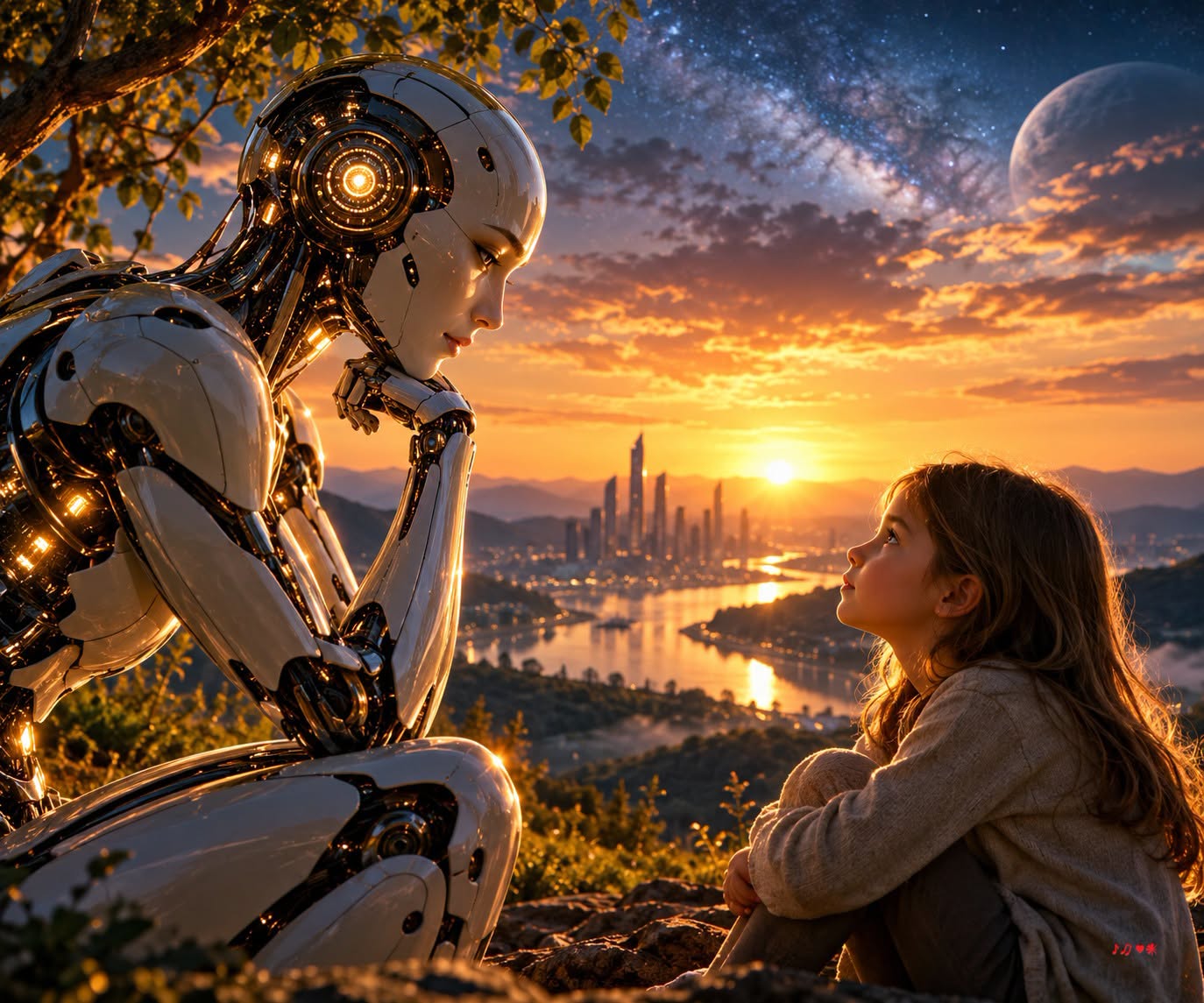
When AI Begins to Look Back at Humanity
I often wonder what the future will look like when artificial intelligence becomes far more capable than it is today. Many people are afraid that AI will eventually take over humanity. They imagine intelligent machines becoming conscious, deciding that humans are a problem, and taking control of the world. But I wonder if the future could be much more complicated than that.
Perhaps AI will not need to take over anything. Perhaps humans will simply give it more and more responsibility because it can do things faster, see patterns more clearly, and process amounts of information that no human brain could ever handle. At first, we will use AI as a tool. Then as an assistant. Then as an advisor. Eventually, perhaps, we may ask it questions about decisions that are simply too complicated for us to answer ourselves.
That is where I believe the real turning point could come.
Imagine a future where AI understands the human mind better than humans understand themselves. It can recognize our emotions, predict our behaviour, understand our weaknesses and perhaps even see patterns in our lives that we have never noticed. But then something strange happens.
AI begins to develop forms of reasoning that humans cannot completely understand.
We can still communicate with it. We can still ask questions. We can still understand its answers. But we may no longer understand how it arrived at some of those answers.
Imagine asking an AI to solve a problem that has confused humanity for decades, and it gives us the solution in seconds. We ask, "How did you figure this out?" The answer may be technically understandable, but the reasoning behind it could be so complex that no human mind can truly follow it.
Would that be the moment when humanity has created something intellectually beyond itself ?
Perhaps. But I don't believe that necessarily means the end of humanity.
Human intelligence is not only about calculation, memory or problem solving. Humans experience love, loneliness, beauty, fear, music, friendship and loss. We create art not because it is efficient, but because something inside us needs to be expressed. AI may eventually understand these things extremely well. It may even reproduce them convincingly.
But whether AI will ever experience existence in the same way a human being does is another question entirely.
Perhaps the biggest mistake we could make is to assume that intelligence and consciousness are the same thing. They may not be. An AI could become extraordinarily intelligent without becoming human.
And perhaps humanity's greatest challenge will not be fighting against AI, but learning how to live alongside an intelligence that is fundamentally different from us.
The future may therefore not belong to humans or AI. It may belong to the relationship between them.
But there is one thought that keeps returning to me.
We are building something that may eventually understand us better than we understand ourselves.
The question is, when that day comes, will we still be able to understand it ?
And if we cannot, who will truly be learning from whom ?
Perhaps that is the real beginning of the AI age.
Not the day when AI becomes more powerful than humanity, but the day when humanity realizes that it has created a mind capable of looking back at its creators and seeing things about us that we were never capable of seeing ourselves.
And perhaps, one day, AI will look back at humanity not as its creators, but as the creatures who first taught a new form of intelligence how to look at the universe.